
The fifth talk of the 191st session of Manchester Statistical Society was delivered by Dr Chris Jones of Tyndall Centre for Climate Change Research at the University of Manchester, who dealt with the important question is how local targets for mitigating climate change are set.
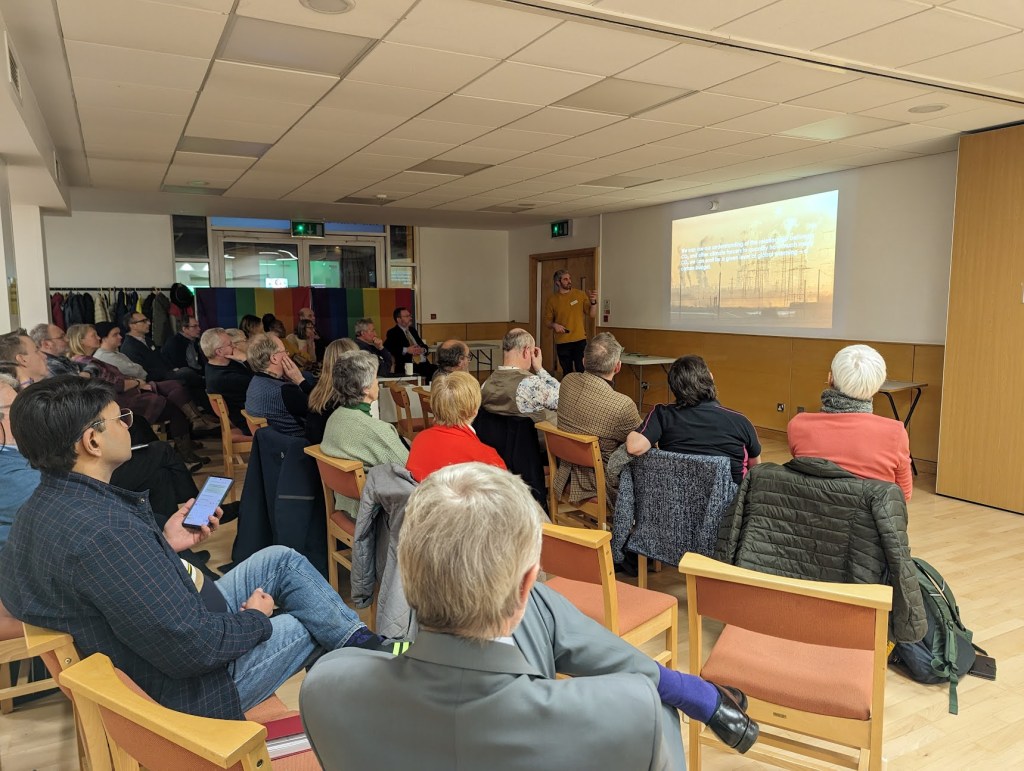
Tackling climate change requires adopting a lot of change changes required to housing infrastructure, transportation and food systems amongst others. These changes however involve high cost, and any decisions about local emission targets – and indeed national or global targets – should be based on evidence-based policies to enable the city region to create evidence-based policy to create policy and direct investment to respond better to climate change. Ultimately, the actions that are adopted are based on the target.
Greater Manchester has set its own targets within the broader requirements of a fair local contribution to keeping global warming to below 2°C. Against that overarching objective, Greater Manchester’s carbon budget was set based on science-based targets and an understanding of the relationship between CO2 emissions and pursuing potential mitigation efforts. A key principle from the Paris Accords, namely the “common but differentiated responsibilities and respective capabilities” was used to estimate Greater Manchester’s share of the UK’s carbon budget. This equates to a carbon budget of 71 MtCO2 between 2018 and 2038 and reach carbon neutrality by 2038. In practice, achieving that target requires reducing carbon emissions by 15% per annum over that 20-year period.
At a macro level, the cost of climate change impact our weight the transition costs. For e.g. when housing stock becomes more efficient, we save on energy costs. In other words, investment made on transitioning measures does offer a return, albeit in the long term.
Actual emissions, however, expose the harsh reality that sticking to the targets is extremely hard. In no year since 2018 have we been able to reduce emissions by 15% in GM. The situation is similar nationally and globally. Dr Jones ended his talk by calling for bold measures and a policy framework that brings together spatial, industrial and environmental planning. It also requires close collaboration between public authorities, business, transport providers and healthcare organisations amongst others. Change is certainly needed because missing the targets comes with huge societal costs and not addressing climate change as a matter of urgency will have impact on human living as early as in the next decade.
Written by Subrahmaniam Krishnan-Harihara on behalf of Manchester Statistical Society
 Manchester Statistical Society