
MSS AI Study Group Meeting on 19th August 2025
Summary of “AI – The Good, the Bad and the Useful!” by Professor Alan Gillies
Professor Alan Gillies’s talk examines the evolution, applications, risks, and management of artificial intelligence (AI), drawing on decades of academic and professional experience.
He begins by reflecting on AI in the late 1980s, when expert systems could solve narrow problems quickly and explain their reasoning but were brittle, costly, and limited in scope. Early machine learning systems adapted to new data and exceeded fixed programming, but they lacked transparency and the ability to assess correctness. This historical contrast sets the stage for today’s AI, which remains “narrow” rather than “general.” Gillies argues that while modern AI is more powerful, data-rich, and accessible due to exponential growth in processing power, true general AI remains science fiction without a fundamental paradigm shift.
Current AI is dominated by large language models (LLMs), chatbots, and data analytics. These tools are widely applied in business and daily life, yet Gillies warns against overestimating their capabilities. LLMs generate plausible but error-prone outputs, are highly sensitive to prompts, and provide facsimiles of reality rather than reliable truth. This “Deus ex machina delusion” risks amplifying misinformation, echoing problems seen with social media.
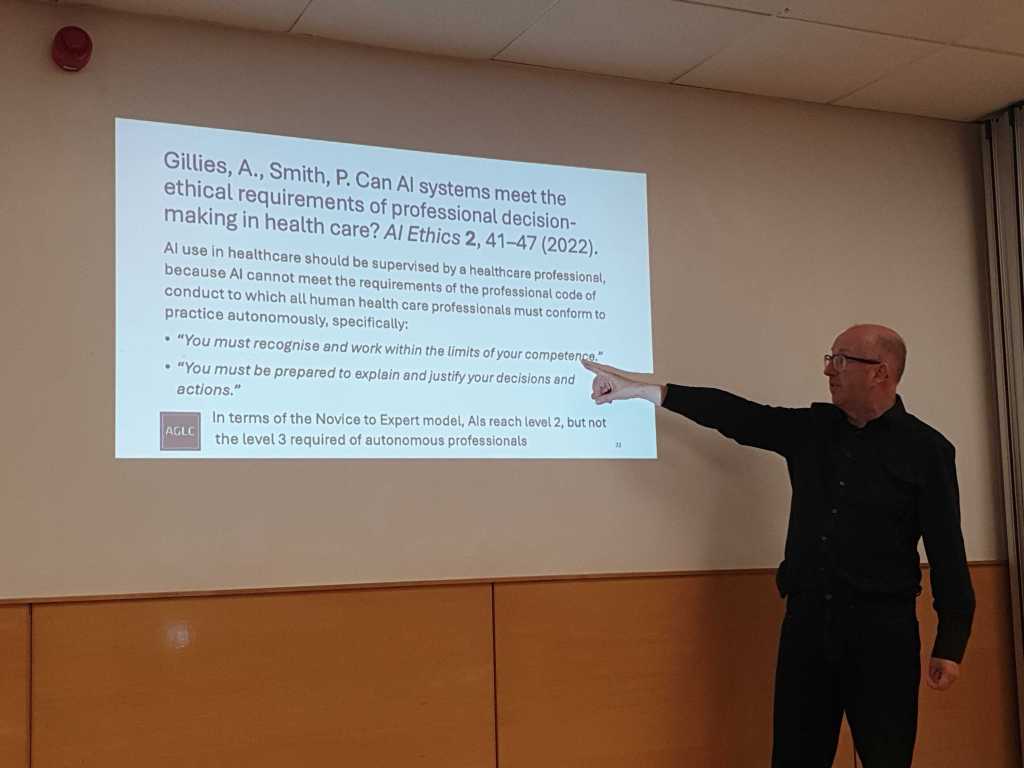
Practical applications span multiple sectors. In education, Gillies integrates AI into teaching by generating assessment materials and encouraging students to engage critically rather than rely on shortcuts. In healthcare, AI supports imaging, pattern recognition, and predictive analytics, with potential to personalise treatment and leapfrog development barriers in developing countries. However, AI cannot yet meet the ethical and professional standards required for autonomous medical practice, so human oversight remains essential. In human resource management (HRM), Gillies has designed training programmes exploring AI’s role in recruitment, employee engagement, and performance monitoring.
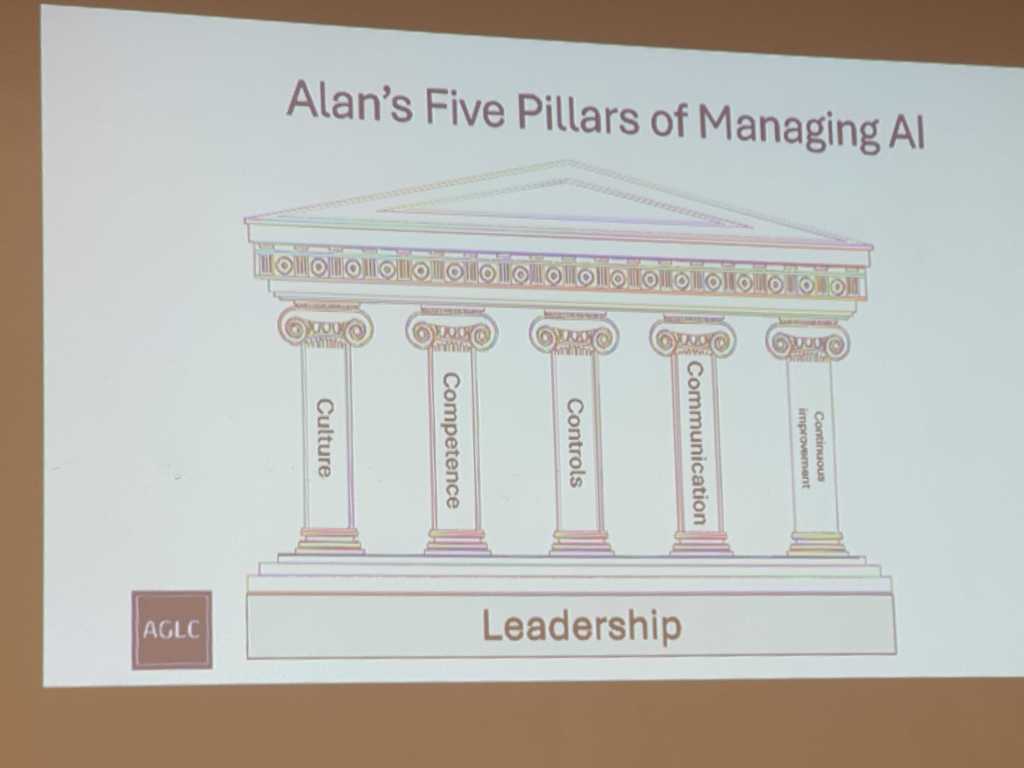
Managing AI responsibly is a central theme. Gillies outlines his Five Pillars of Managing AI—culture, competence, controls, communication, and continuous improvement—anchored by effective leadership. Good practice requires organizations to treat AI as a shared responsibility, assess staff competency, monitor and adapt risk management processes, ensure open communication, and continually learn from failures.
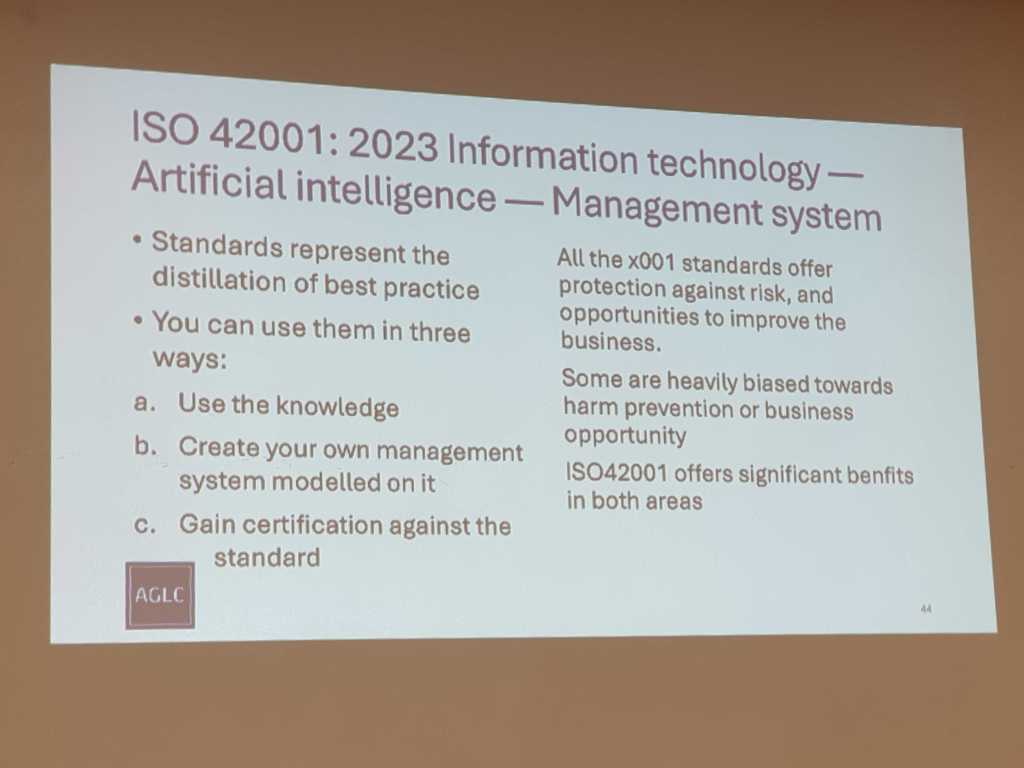
He also highlights the significance of ISO/IEC 42001:2023, the new standard for Artificial Intelligence Management Systems (AIMS). This framework emphasizes ethical AI, risk management, governance, and compliance. Organisations can use it as guidance, a model for internal systems, or pursue certification, thereby both reducing harm and creating opportunities.
In conclusion, Gillies underscores AI’s dual nature: it offers immense benefits to business, education, and healthcare but carries risks of error, bias, and over-reliance. The key lies in ethical, well-managed deployment, continuous learning, and leadership that adapts to a rapidly changing technological landscape.
You may like to read more at:
or see how has applied AI on his hobbysite(s) at
https://hifihobbyist.net and https://hifihobbyist.podbean.com/
Contact Professor Alan Gillies at professor@alangillies.com


 Manchester Statistical Society