AI Augmentation: What Actually Works for Businesses, by Tom Brandwood, Chief Technology Officer for Traverse Automation
MSS AI Study Group Meeting on 21st April 2026
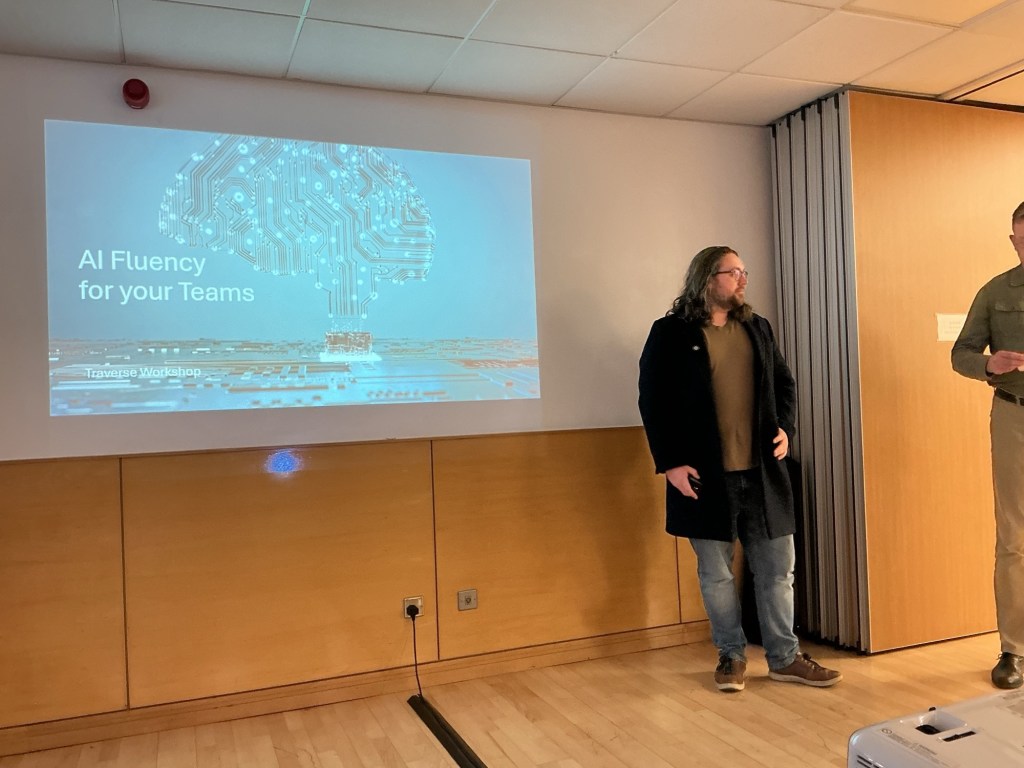
Tom Brandwood, Chief Technology Officer at Traverse Automation, delivers a detailed and pragmatic overview of artificial intelligence, grounded in his company’s transition from traditional automation to AI-enabled solutions. He begins by describing how Traverse initially focused on understanding business processes and building scripts, tools, and web applications to automate repetitive tasks. Over time, the company adopted AI technologies as they became more capable and cost-effective, moving from early experimentation with limited tools to consultancy and practical implementation in day-to-day business operations.
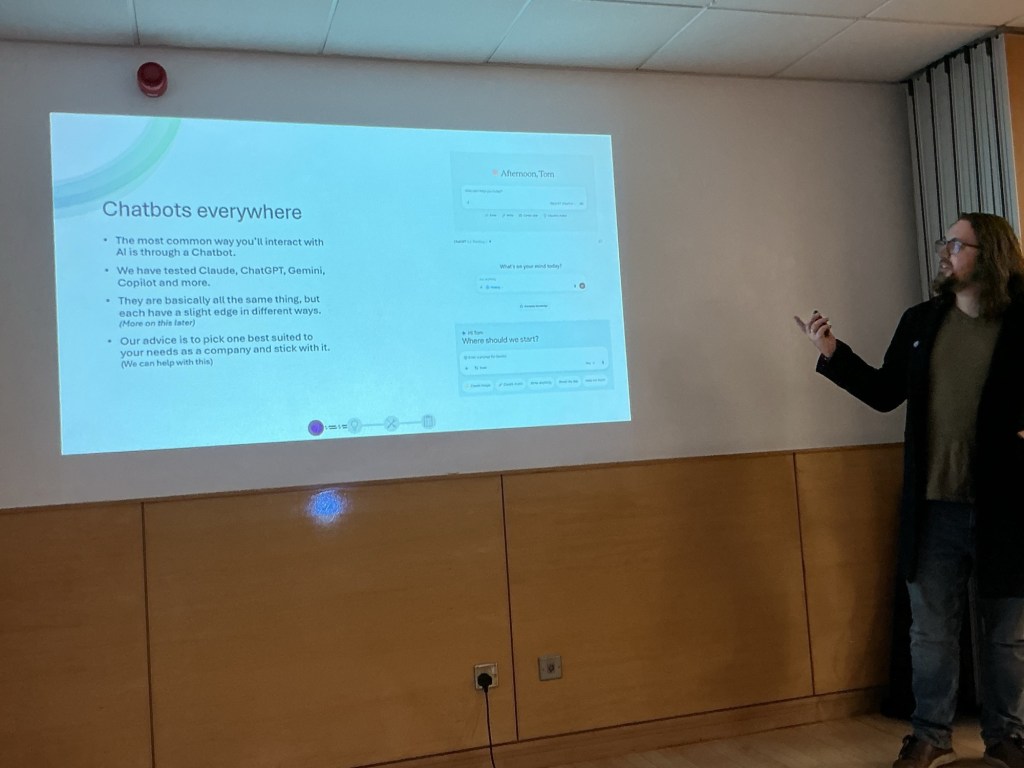
Brandwood explains that modern AI tools—particularly chatbot-style systems like Claude, GPT, and others—are now the primary interface for most users. While these tools share similar underlying capabilities, each has strengths, so businesses should select one that suits their needs and standardise its use. He strongly advises against “shadow AI”, where employees use personal accounts, as this creates risks around sensitive data exposure. Governance is therefore essential: organisations should enforce approved tools, use business accounts, and ensure that responsibility for outputs remains with humans.
A key theme throughout the talk is that AI does not “think” in a human sense. Brandwood demystifies how large language models work, describing them as advanced predictive systems that tokenise input, map it into high-dimensional vectors, and generate outputs based on probability. This means their behaviour is shaped entirely by input and training data, with some randomness. As a result, while AI excels at tasks such as analysing data, summarising information, and generating content, it is also prone to “hallucinations”—confident but incorrect outputs. He stresses that users must remain critical, as errors may not always be obvious.
To get the best results, Brandwood highlights the importance of prompt design. Clear, detailed, and specific instructions are crucial, as ambiguity leads to poor or generic outputs. He recommends structuring prompts carefully, iterating by refining the original request rather than arguing with outputs, and providing examples where possible. Techniques such as assigning roles can help, but should not replace specificity. He also discusses features like writing styles, custom instructions, and reusable “skills”, which allow users to embed consistent behaviours or guidelines. However, he warns that overly broad or conflicting instructions can reduce effectiveness.
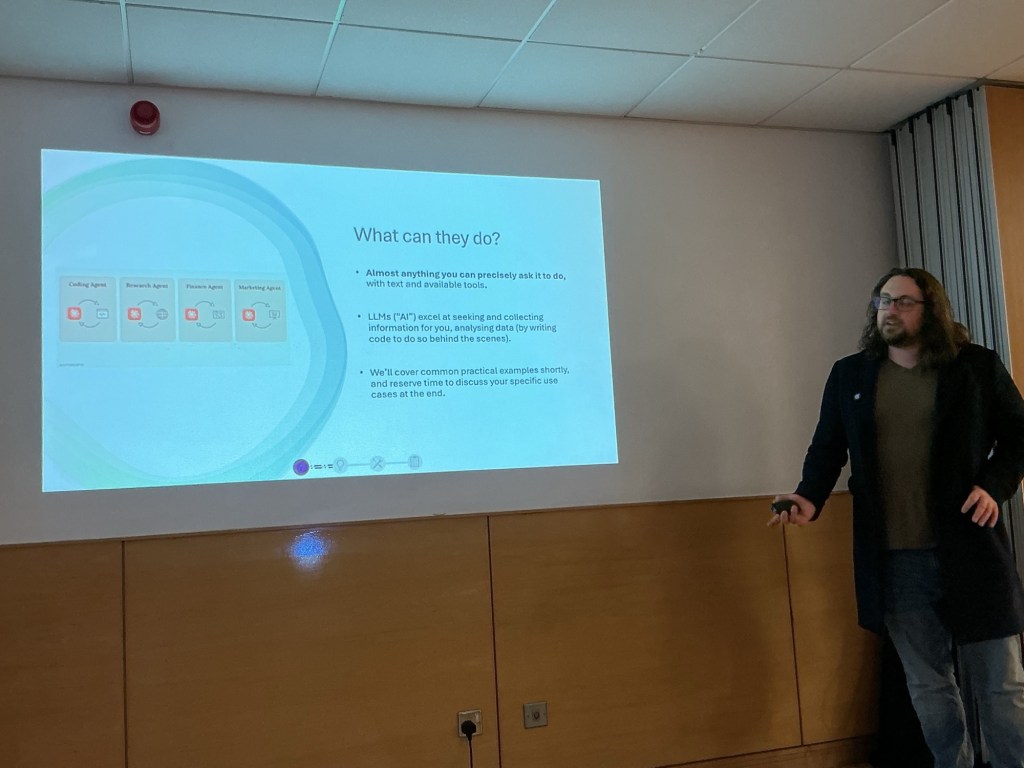
The talk then moves to AI “agents”, which Brandwood describes as systems combining instructions with tools that can act in loops to achieve goals. These agents can perform multi-step tasks, such as retrieving data from files, generating charts, and producing reports. He gives examples including research agents that gather information from the web, knowledge agents connected to internal company systems, and custom-built agents for project management. These can provide valuable insights, such as identifying workload imbalances or summarising complex data. However, he cautions against giving agents full autonomy, recommending instead that they produce outputs for human review rather than making decisions independently.
In software development, Brandwood highlights tools like Claude Code, which significantly accelerate coding by generating and reviewing code, creating documentation, and automating tasks. While these tools can improve productivity and even catch errors, he emphasises the importance of human oversight, structured workflows, and testing. Developers should break tasks into manageable chunks, review outputs carefully, and avoid allowing AI to make unchecked changes to production systems.
He also addresses practical considerations such as cost and efficiency. Token usage can be high, particularly with advanced models, so users should select appropriate models for each task and reduce unnecessary processing, such as excessive “thinking” steps. AI is particularly valuable for tasks like data analysis, meeting transcription, report generation, and prototyping, while other areas—such as email drafting—may risk producing generic, low-value content if overused.
In the concluding discussion, Brandwood reflects on broader implications. He acknowledges concerns that widespread AI use may lead to homogenised, less creative outputs, echoing historical parallels with earlier digital tools. He reiterates that AI lacks true memory, emotion, and lived experience, functioning instead through repeated context processing within technical limits. While advancements in agents and models are rapid, many solutions remain immature, with security, cost, and reliability challenges still evolving.